An Art Deco landmark rescued and transformed
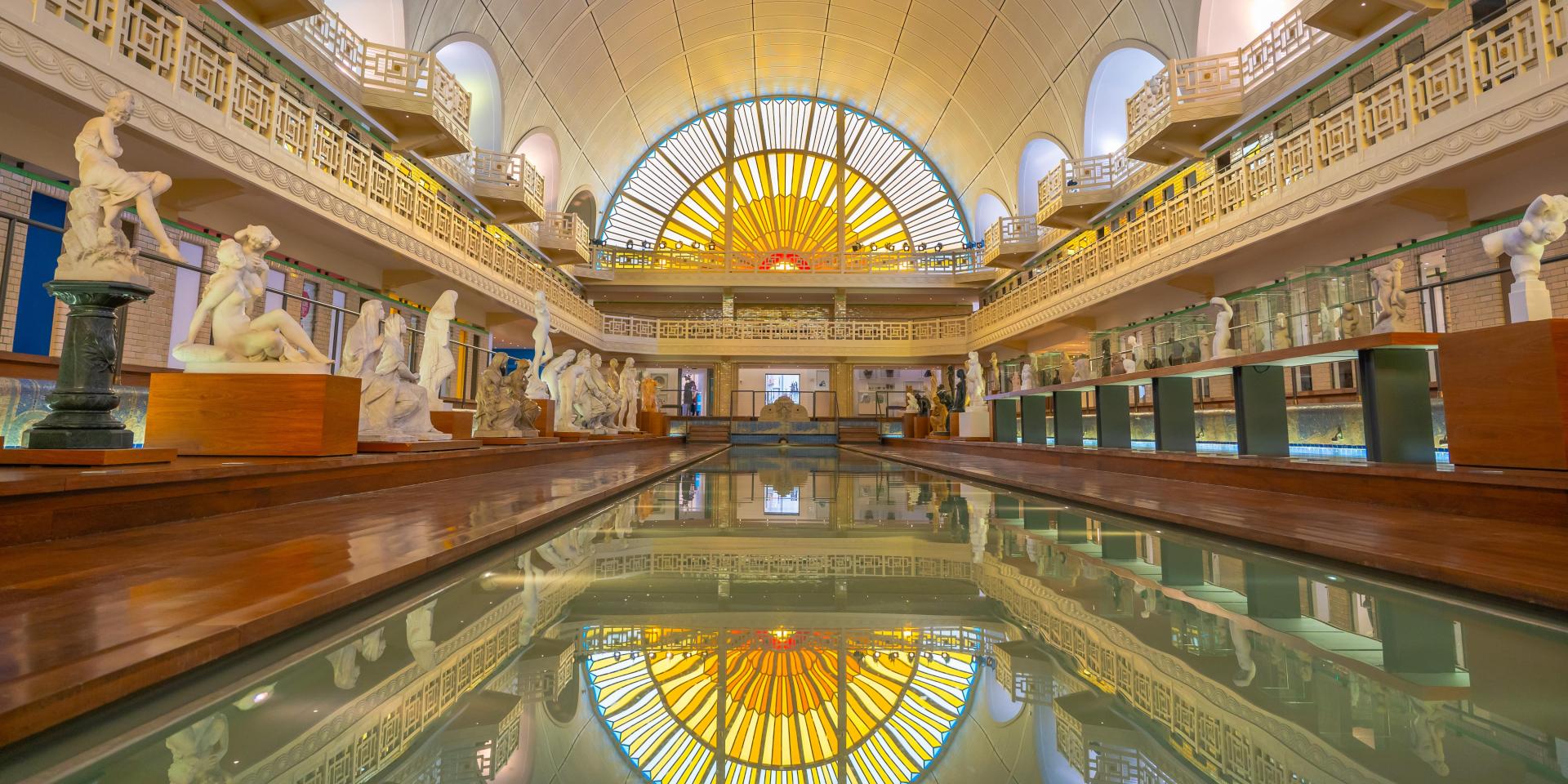
La Piscine, the André Diligent Museum of Art and Industry, occupies Roubaix’s former municipal swimming pool, an emblematic building of the interwar years designed by architect Albert Baert and inaugurated in 1932. In the heart of the northern textile city, the pool was a place of health and well-being as well as an aesthetic landmark, with its large central pool, rows of changing cubicles, galleries and radiating sun-shaped stained-glass windows. Closed in 1985 for safety reasons, it escaped abandonment through a cultural conversion project led by the municipality and supported by the state and local authorities. Architect Jean-Paul Philippon oversaw the transformation, respecting the original architecture while adapting it to museum requirements. The museum opened to the public in 2001 as the André Diligent Museum of Art and Industry, in tribute to the former mayor of Roubaix who had championed the conversion.
An identity inherited from a manufacturing city
Roubaix, a historic centre of wool and manufacturing, had possessed collections since the nineteenth century, assembled by the municipal museum of art and industry, founded in the mid-1800s to support the training of textile workers, designers and industrialists. Sample books, pattern books, business archives, technical fabrics, lace and velvet, as well as ceramics, ironwork, furniture and art objects, formed a collection intended both to pass on skills and to inspire creators. By embracing this heritage, La Piscine connects industrial heritage and art history, offering a distinctive setting in which the city’s material memory is displayed within a civic building emblematic of its golden age.
Collections: from textiles to fine art
The historic core of the collections concerns textiles and applied arts, with objects illustrating the techniques, styles and innovations of Roubaix’s manufacturers and, more broadly, European textile regions. Sample books, pattern designs, printed fabrics, embroidery and lace sit alongside machines and tools, bearing witness to a rich industrial ecosystem in which creativity responded to international markets. This documentary resource, long used by schools and workshops, is now presented in a way that brings technical heritage into dialogue with artistic expression.
As it developed, the museum also assembled a fine-art collection centred on the nineteenth and twentieth centuries, combining painting, sculpture, graphic arts and decorative arts. Sculpture plays a notable role, presented in dialogue with the pool and its bays in a display that makes use of light and reflections. The decorative arts, including ceramics, glass and furniture, complete the collection, tracing the transition from Art Nouveau to Art Deco and then the modern movements of the twentieth century. Particular attention is paid to artists, craftspeople and manufacturers whose work bridges industry and creativity, a curatorial approach true to the museum’s identity.
Temporary exhibitions and cross-disciplinary programmes
La Piscine has distinguished itself through temporary exhibitions bringing together textiles, fashion, design and the visual arts, presenting both historic creators and contemporary perspectives on materials, colour and form. The dialogue between heritage and creation is a recurring theme, whether revisiting archives, presenting monographic exhibitions or highlighting decorative collections often little seen in general art museums. These programmes offer new ways of reading the permanent collections, build connections with the local economy and place Roubaix within a broader map of the applied arts.
Displays shaped by water
La Piscine’s distinctiveness lies in the way the original architecture shapes the visitor experience. The large pool, retained and given a new purpose, has become a reflecting pool that extends the views and animates the light filtered through the sun-shaped windows. The restored changing rooms, walkways and cubicles provide exhibition alcoves alternating objects, sculptures and textile displays. Devised by Jean-Paul Philippon for the 2001 reopening, the presentation respects the volumes, materials and Art Deco lines while incorporating the conservation, climate-control and lighting systems required by contemporary museum standards.
The effect of a “secular cathedral” stems from the height of the central hall, the rhythm of its openings and the interplay of materials, including pale ceramic tiles, patinated metal and woodwork, characteristic of swimming pools of the period but rarely preserved so intact. The layout makes it easy to move between intimate spaces and wider views, turning each bay into a chapter in a story combining social history, manufacturing techniques and artistic practice.
2018: an extension on a larger scale
In response to public success and conservation needs, the museum undertook a major extension and renovation, completed in 2018 under the same architect, Jean-Paul Philippon. The project added several thousand square metres of usable space, creating new exhibition rooms, an enlarged reception area, storage and restoration workshops, as well as a garden connecting the museum more naturally to its neighbourhood. Discreet and respectful of the surrounding urban scale, the extension continues the original logic of conversion, using materials and colours in harmony with the existing building.
The reopening enabled the permanent collections to be rearranged, the textile collection to be given greater prominence, the displays of decorative arts and sculpture to be improved, and more flexible conditions to be provided for major temporary exhibitions. It was accompanied by technical upgrades to meet requirements for accessibility, preventive conservation and the movement of works. This expansion consolidated La Piscine’s place among French museums, particularly within the network of museums housed in converted industrial buildings.
Education, research and local roots
A City of Roubaix institution accredited as a “Musée de France”, La Piscine develops programmes for school groups, families and non-specialist visitors, with workshops, themed visits and routes combining sensory discovery with documentary content. Its substantial textile collection and business archives make educational projects possible with regional art and design schools and specialist training programmes, continuing the educational purpose inherited from the first nineteenth-century industrial museum.
The museum regularly collaborates with other institutions and lends works to exhibitions in France and abroad, helping to bring recognition and visibility to collections long regarded as technical or utilitarian. Publications, catalogues and thematic dossiers produced for exhibitions contribute to research into industrial history and artistic exchange between workshops, manufacturers and artists. The website and digital tools also offer resources for exploring the collections, especially useful for sample books and pattern archives that are difficult to display continuously for conservation reasons.
A showcase for heritage in motion
La Piscine forms part of a wider movement to rehabilitate industrial heritage in the Hauts-de-France region, where former industrial sites and civic buildings are finding new uses. In Roubaix, it connects with other cultural and heritage institutions, contributing to an urban narrative in which the memory of manufacturing supports dynamism, attractiveness and education. Through the coherence of its setting, collections and scholarly programme, the museum shows how everyday heritage can foster awareness of creativity, social history and techniques.
An institution with a strong reach
Since its creation, La Piscine has attracted a broad audience through a hybrid identity, neither strictly an art museum nor a technical museum, but a place where objects are viewed and understood at the intersection of their uses, forms and contexts. Its municipal status, local roots and organic connection to Roubaix’s textile history explain an exhibition programme and acquisition policy centred on the coherence of its collections. By increasing capacity, the 2018 extension made more ambitious exhibitions possible without upsetting the balance between permanent and temporary displays or the intimate character of certain rooms.
Nationally, La Piscine has become a case study in successful heritage conversion, often cited for the quality of its architecture, the relevance of its displays and the connection between its collection and the history of a city. Internationally, it belongs to a constellation of museums housed in repurposed twentieth-century buildings, offering experiences that involve both observing works and inhabiting a space.
Sources
Official website of La Piscine, André Diligent Museum of Art and Industry: museum presentation, history and collections. https://www.roubaix-lapiscine.com
“La Piscine (André-Diligent Museum of Art and Industry)”, reference article, Wikipedia, consulted for the history of the pool, the 2001 conversion and the 2018 extension. https://fr.wikipedia.org/wiki/La_Piscine_(mus%C3%A9e_d%27art_et_d%27industrie)
Le Monde, “À Roubaix, La Piscine agrandie et rénovée s’ouvre au public”, 19 October 2018, on the extension, its architectural approach and the reorganisation of the collections. https://www.lemonde.fr
France 3 Hauts-de-France, “Roubaix : La Piscine rouvre après deux ans de travaux d’extension”, 20 October 2018, on the reopening, the new spaces and visitor reception. https://france3-regions.francetvinfo.fr/hauts-de-france
La Piscine press materials on the 2018 reopening: technical information on the extension, displays and conservation spaces. https://www.roubaix-lapiscine.com/medias
Heritage information on Roubaix municipal swimming pool and its architect Albert Baert, local and regional resources from the City of Roubaix, archives and inventories. https://www.roubaix.fr