A museum born from a World’s Fair railway station
The Musée d’Orsay occupies the former Gare d’Orsay, built for the 1900 World’s Fair on the Seine’s left bank, opposite the Louvre. Designed by architect Victor Laloux for the Paris-Orléans railway company, the station combined a metal structure with stone and glass and also housed a hotel, reflecting Beaux-Arts aesthetics and turn-of-the-century faith in technological progress. Too short for the growing long-distance trains of the twentieth century, the station declined from the 1930s onward. It was partly repurposed, then occasionally used as a film set and exhibition venue, before being threatened with demolition. Listed as a historic monument in 1978, the complex was ultimately saved; in 1977 the state decided to create a museum devoted to art of the second half of the nineteenth century, providing a chronological link between the Louvre and the Centre Pompidou.
Following a competition, ACT architecture (Renaud Bardon, Pierre Colboc and Jean-Paul Philippon) was entrusted with converting the building, while Italian architect Gae Aulenti designed the interior displays. Inaugurated in 1986, the approach placed the works within the monumental original hall, creating a succession of islands and galleries for a clear route through painting, sculpture, decorative arts, architecture and photography. On 9 December 1986 President François Mitterrand inaugurated the museum, marking the transformation of railway infrastructure into a major cultural institution.
Major collections for a changing century
The Musée d’Orsay covers 1848 to 1914, a long nineteenth century that saw the birth and development of Realism, Impressionism, Post-Impressionism, Symbolism and Art Nouveau. This time span brings official salons and avant-gardes into dialogue, from Courbet to Cézanne and from Manet to Seurat, encompassing all the visual arts. The Impressionist and Post-Impressionist painting collection is among the world’s most important, with masterpieces including Édouard Manet’s Olympia and Le Déjeuner sur l’herbe, Auguste Renoir’s Bal du moulin de la Galette and Georges Seurat’s Le Cirque, a late example of Pointillism in a modern art seeking a science of colour. The rooms devoted to Vincent van Gogh include L’Église d’Auvers-sur-Oise and La Nuit étoilée sur le Rhône, demonstrating the distinctive character of his brushwork and palette around the turn of the 1890s.
Beyond painting, the museum holds an outstanding collection of sculptures. Sculpture from the second half of the nineteenth century is represented by Jean-Baptiste Carpeaux, Auguste Rodin and Camille Claudel, whose work embodies the sensitive and expressive turn of the fin de siècle. Visitors encounter major versions of Rodin’s La Porte de l’Enfer, whose Dantean imagery condenses the artist’s visual and literary ambition, as well as sculptural groups illustrating Naturalism and Symbolism. The decorative arts play a central role, with Art Nouveau ensembles by Hector Guimard, Émile Gallé and Louis Majorelle, alongside furniture and glass evoking the ideal of a total work of art, or Gesamtkunstwerk, in the home and everyday life. Finally, the photography collections, developed around the medium’s pioneers and its growth in the nineteenth century, offer a documentary and aesthetic counterpoint to revolutions in painting.
The route is designed to show exchange between disciplines and aesthetic influences in an era when science, industry, urban planning and the arts shaped one another. Paintings by Monet and Pissarro of railway stations and Parisian boulevards converse with Haussmann’s urban planning, while the growth of illustrated newspapers and posters is reflected in the attention paid to modern life by Degas and Toulouse-Lautrec. Major Realist works, including Gustave Courbet’s L’Origine du monde, directly expose tensions between academic tradition and the truth of their subjects, tensions that fuelled new ways of seeing until 1914.
Architecture conceived as a grand narrative
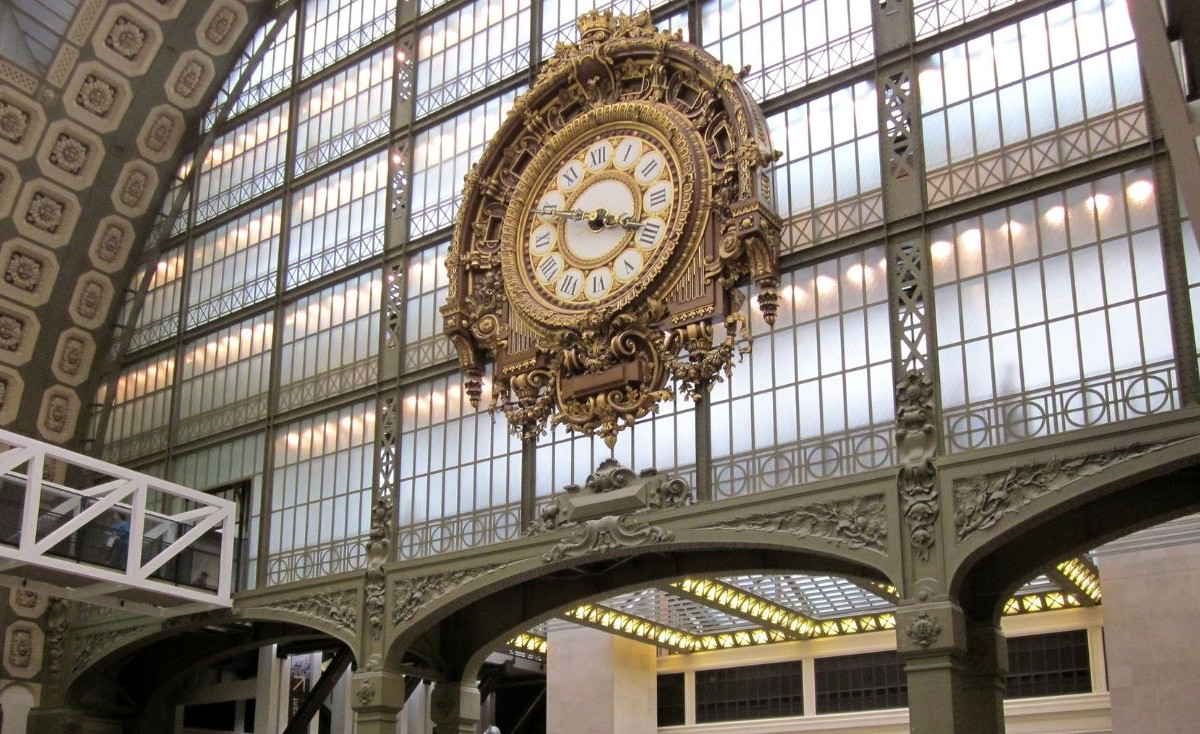
With its great glass-roofed hall and monumental clocks, the museum remains one of Paris’s visual landmarks. The 1980s conversion exploited the perspective of the former railway hall, transforming it into a central avenue devoted particularly to sculpture, punctuated by massive pale-stone plinths that establish rhythm and visual pauses. Gae Aulenti chose restrained materials and geometric volumes that structure the space without erasing the station’s character, creating museum “boxes” for thematic displays and mezzanines opening onto the vast hall. Above, bright rooms house the Impressionists, while large windows frame the city, placing the works in a tangible relationship with the urban landscape in which they were created.
This converted architecture is part of the institution’s historical message. By bringing together the traces of nineteenth-century infrastructure and masterpieces associated with industrialisation, pictorial modernity and social change, the museum offers an embodied narrative of modernity. The former railway system, a symbol of speed and movement, becomes a narrative device for the circulation of ideas, styles and techniques, offering a lesson in art history that is also a lesson in architecture and heritage.
Education, research and audiences
From its opening, the Musée d’Orsay made education and the sharing of knowledge a strategic priority. It offers thematic routes, guided tours and audio guides in several languages to support a varied audience, from newcomers to specialists. Its cultural programme uses an auditorium for lectures, screenings and concerts that place works in the literary and musical contexts so important to the nineteenth century. Workshops and educational activities are offered to schools and families, while the documentation and research centre provides resources on artists, movements and techniques of the period.
Digital interpretation has grown over the years, with online dossiers, detailed artwork entries and virtual exhibitions offering remote access to the collections. The institution also publishes exhibition catalogues and scholarly books, extending the museum experience through a sustained editorial programme. Together with regularly renewed displays, these resources keep interpretations of the collections up to date and encourage new historical connections.
Landmark exhibitions and international dialogue
The Musée d’Orsay’s temporary exhibitions have helped renew perspectives on the nineteenth century and its legacy. In 2018, “Picasso. Bleu et Rose”, presented with the Musée national Picasso-Paris, highlighted the artist’s development from 1900 to 1906, placing his blue and rose periods on the threshold of Cubism and in relation to nineteenth-century masters. In 2019, “Le Modèle noir de Géricault à Matisse” opened a historical and critical inquiry into the representation of Black models in French art of the nineteenth and early twentieth centuries, connecting art history, social history and postcolonial studies. In 2015–2016, “Splendeurs et misères. Images de la prostitution, 1850-1910” examined a central theme of modernity, from Manet to Toulouse-Lautrec, placing images of sex workers in their social and legal context.
More recently, “Manet / Degas” compared two central figures of Realism and Impressionism, highlighting similarities and differences in their careers, subjects and techniques through an international partnership. Grounded in scholarly research and dialogue with major European and American institutions, these exhibitions affirm Orsay’s role as a platform for the circulation of works and knowledge. They deepen understanding of a period in which artists, dealer networks, collectors and museums shaped a market and a historiography that are now global.
A distinctive place among museums
Its chronological scope places the Musée d’Orsay between the Louvre, whose collections cover art up to the mid-nineteenth century, and the Centre Pompidou, devoted to modern and contemporary art. Its complementary relationship with the Musée de l’Orangerie, home to Monet’s Water Lilies and a major modern art collection, makes the story of art in France and Europe between 1860 and 1930 clearer. By bringing together painting, sculpture, decorative arts, architecture and photography, Orsay offers a cross-disciplinary approach reflecting the encyclopaedic ambition of museums while preserving the distinctive character of each medium.
The museum’s international recognition rests both on the richness of its permanent collections and on its capacity to renew interpretations of the nineteenth century. Over the years the institution has rehung collections, notably in the Impressionist and Post-Impressionist sections, refining thematic and chronological organisation and taking account of developments in research. This sustained contextual work, combined with the unique spatial experience of the former station, makes the Musée d’Orsay an exemplary heritage conversion and a reference point for studying and contemplating the arts of emerging modernity.
Sources
Official Musée d’Orsay website, “History of the museum” and institutional pages on the station’s conversion, the architects ACT architecture and Gae Aulenti, the 1986 opening and the chronological scope of the collections. https://www.musee-orsay.fr/
French Ministry of Culture Mérimée database, entry on the former Gare d’Orsay, now the Musée d’Orsay, covering its construction in 1900, historic-monument protection and conversion. https://www.pop.culture.gouv.fr/
Musée d’Orsay, “Collections” and “Works” pages for Manet, Renoir, Seurat, Van Gogh and Courbet, as well as Art Nouveau, Rodin and Claudel. https://www.musee-orsay.fr/oeuvres
Musée d’Orsay exhibition dossiers: “Picasso. Bleu et Rose” (2018), “Le Modèle noir de Géricault à Matisse” (2019), “Splendeurs et misères. Images de la prostitution, 1850-1910” (2015–2016), and “Manet / Degas” (2023), with scholarly context, work lists and partners. https://www.musee-orsay.fr/expositions
Encyclopædia Britannica, “Musée d’Orsay” and reference articles on Impressionism and major artists of the period, for international context. https://www.britannica.com/topic/Musee-dOrsay